 Tel. colombia
  us phone



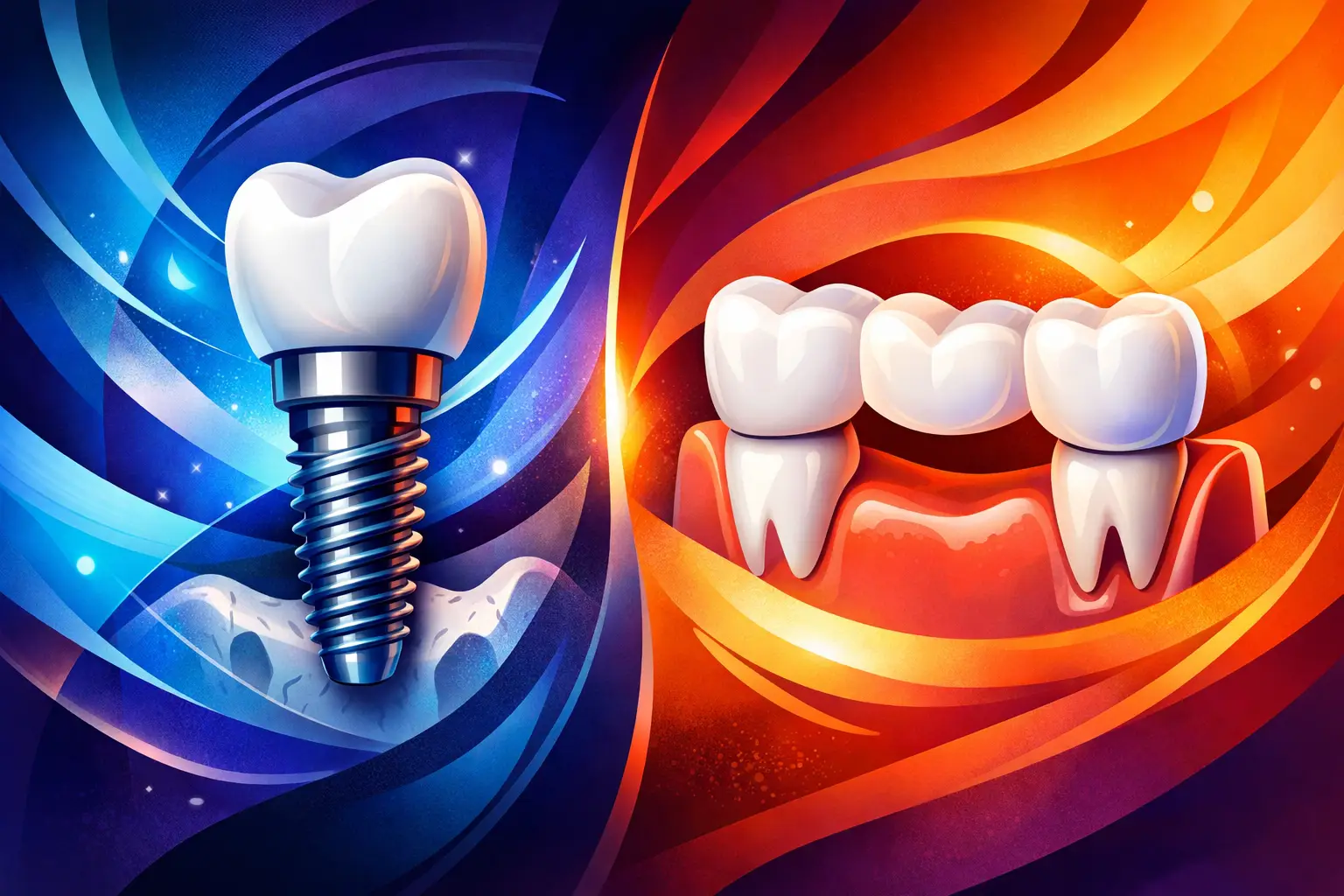
A missing tooth changes more than a photograph. It can alter how confidently you speak, which foods you enjoy, and how the teeth beside the space function over time. The decision between dental implants versus bridges is therefore not simply about filling a gap. It is about choosing a solution that respects your health, facial aesthetics, lifestyle, and long-term vision for your smile.
For patients traveling to Cartagena for premium restorative dentistry, this choice deserves a personalized clinical evaluation rather than a one-size-fits-all recommendation. Both treatments can restore a complete, beautiful smile. Their differences lie in how they are supported, how they affect neighboring teeth, the timeline of care, and the investment they require over the years.
Dental Implants Versus Bridges: The Essential Difference
A dental implant replaces the root and visible crown of a missing tooth. A biocompatible titanium implant is placed in the jawbone, where it gradually integrates with the bone. Once healing and planning requirements are met, a custom crown is attached above the gumline. The result is a restoration designed to look, feel, and function much like a natural tooth.
A traditional dental bridge replaces the visible portion of one or more missing teeth by connecting a prosthetic tooth to crowns placed on the teeth beside the gap. Those adjacent teeth serve as anchors. In some cases, an implant-supported bridge may be recommended for multiple missing teeth, but this is a different solution from a conventional bridge supported by natural teeth.
The distinction matters because an implant is independent, while a traditional bridge relies on neighboring teeth. Neither option is automatically superior for every patient. The right choice depends on the condition of your mouth and the outcome you want to protect.
Why Implants Are Often the Preferred Long-Term Option
For a single missing tooth, an implant can preserve healthy adjacent teeth because they do not need to be reshaped to support the restoration. This is a major advantage for patients whose surrounding teeth are intact and free from large fillings or crowns.
Implants also stimulate the jawbone when you bite and chew. After tooth loss, the bone in that area can gradually resorb because it no longer receives that stimulation. While an implant cannot reverse every effect of previous bone loss, it can help maintain the bone after placement and support a more stable facial foundation over time.
From an aesthetic perspective, a meticulously planned implant crown can emerge naturally from the gumline and be matched to the color, shape, translucency, and character of your surrounding teeth. This level of detail is especially valuable in the smile zone, where even a small difference in contour can affect the overall harmony of your expression.
Implants are also fixed in place and do not require special removal or unusual daily routines. You brush and floss around them carefully, much as you would with natural teeth. With excellent hygiene, routine professional maintenance, and appropriate bite management, the implant itself can serve for decades. The crown attached to it may eventually need replacement due to normal wear.
When an Implant Requires More Planning
An implant is a surgical treatment, and thoughtful planning is part of its strength. Your dentist must assess bone volume, gum health, bite forces, medical history, and the exact position of the future crown. Advanced imaging and digital smile planning allow the treatment to be designed around both health and aesthetics.
If bone has diminished after a tooth has been missing for years, a bone graft may be needed before or during implant placement. Patients with untreated gum disease, uncontrolled diabetes, heavy smoking habits, or certain medical conditions may also need additional preparation or may not be ideal candidates at that moment.
The timeline can be longer than a bridge because healing is often required before the final crown is placed. For international patients, this may mean coordinating treatment in carefully planned stages. A distinguished dental team will explain what can be completed during each visit and will never rush biological healing merely to meet a travel schedule.
When a Dental Bridge Is the Smarter Choice
A bridge remains an excellent and refined restorative option in the right circumstances. It can often be completed more quickly than an implant and may be particularly practical when the teeth on either side of the missing space already need crowns because of extensive decay, fractures, or older restorations.
In that situation, using those teeth as bridge supports may allow the entire area to be restored with one integrated treatment. A high-quality ceramic bridge can be exceptionally lifelike, restoring chewing ability and the visual continuity of the smile without surgery.
A bridge may also be preferred when an implant is not clinically advisable, when a patient does not wish to undergo surgery, or when timing is a priority. For example, someone preparing for a wedding, professional milestone, or extended stay may need an elegant fixed restoration within a more defined timeframe.
The trade-off is that a traditional bridge requires preparation of adjacent teeth. Even when those teeth are healthy, a portion of their enamel must be reduced to make room for the supporting crowns. Bridges also do not stimulate the jawbone beneath the missing tooth, so bone changes may continue slowly in that area.
Appearance, Comfort, and Everyday Function
Both implants and bridges can be crafted from premium ceramic materials that complement a sophisticated smile design. The difference is less about whether one can look beautiful and more about how the restoration is designed, placed, and maintained.
An implant crown offers the advantage of standing independently, allowing access between teeth for flossing. A bridge connects multiple units, so cleaning beneath the replacement tooth requires a floss threader, interdental brush, or water flosser. Patients who are committed to a precise hygiene routine can maintain a bridge successfully, but this added step should be considered honestly.
Comfort is similarly individual. Once fully healed, many implant patients report that their restoration feels remarkably close to a natural tooth. A bridge can also feel comfortable and stable, particularly when it is precisely fitted and the supporting teeth are healthy. If a bridge becomes loose or decay develops beneath one of its crowns, the restoration may need more extensive repair or replacement.
Cost Is More Than the First Number You See
A bridge generally has a lower initial cost than a single implant because it does not involve surgical placement, imaging, or possible grafting. That can make it appealing for patients comparing immediate expenses.
Yet the long-term picture can be different. A conventional bridge may need replacement after years of service, and the health of its supporting teeth remains central to its success. If one supporting tooth develops a significant problem, the entire bridge can be affected. An implant may require a greater investment upfront, but its independent structure and potential longevity can make it a compelling value over time.
For patients from the United States, dental tourism should never mean choosing based on price alone. The value of treatment rests on diagnostic quality, materials, laboratory artistry, infection-control standards, clinician expertise, follow-up planning, and transparent communication. A beautiful result is not a product purchased off a menu. It is the result of disciplined planning and skilled execution.
Choosing the Right Restoration for Your Smile
The most useful question is not, “Which option is best?” It is, “Which option is best for my teeth, bone, gums, timeline, and expectations?” A comprehensive consultation should examine the missing-tooth site, the health of neighboring teeth, your bite, smile line, periodontal condition, and medical background.
An implant may be the stronger choice when surrounding teeth are healthy, bone conditions are favorable or can be improved, and you want the most independent long-term replacement possible. A bridge may be the wiser choice when adjacent teeth already require crowns, surgery is unsuitable, or a shorter treatment timeline is essential.
At Sonrisa Perfecta Dental, restorative planning can unite implantology, advanced aesthetics, and facially balanced smile design so the final result is considered from every angle. The goal is not merely to replace a tooth, but to restore the poise of a smile that feels entirely your own.
Your missing tooth has a clinical story, and the right restoration should honor it. Choose the option that gives you confidence not only when you leave the dental chair, but every time you laugh, dine, speak, and smile without hesitation.